Route 53 Section
What is DNS
- Domain Name System which translates the human friendly hostnames into the machine IP address
- www.google.com => 172.2.17.18.36
- DNS is the backbone of the internet
- DNS uses hierachical naming structure
DNS Terminologies
- Domain Registrar: Amazon Route 53, GoDaddy, …
- DNS Records: A, AAAA, CNAME, NS, …
- Zone file: contains DNS records
- Name Server: resolves DNS queries (Authoritative or Non- Authoritative)
- Top Level Domain (TLD): .com, .us, .in, .gov, .org, …
- Second Level Domain (SLD): amazon.com, google.com, …
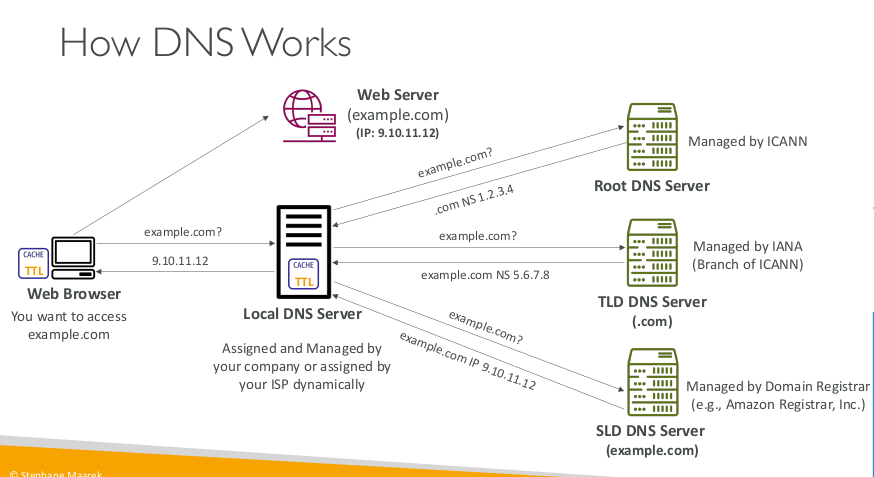
How DNS works
- Web browser -> Local DNS Server:
- Root DNS Server managed by ICANN (res: .com NS 1.2.3.4)
- TLD DNS Server managed by IANA (res: domain NS 5.6.7.8)
- SLD DNS Server managed by Domain Registrar (res: domain IP)
Amazon Route 53
- A highly available, scalable, fully managed and Authoritative DNS
- Authoritative = the customer (you) can update the DNS records
- Route 53 is also a Domain Registrar
- Ability to check the health of your resources
- The only AWS service which provide 100% availability SLA
- Why Route 53? 53 is a reference to the traditional DNS port
Route53 - Records
- How you want to route traffic for a domain
- Each record contains:
- Domain/subdomain Name: example.com
- RecordType: e.g A or AAAA
- Value: 12.34.56.78
- Routing Policy: How Route 53 responds to queries
- TTL: amount of time the record cached at DNS resolvers
- Route 53 supports the following DNS record types:
- A / AAAA / CNAME / NS
- CAA / DS / MX / NAPTR / PTR / SOA / TXT / SPF / SRV
Route 53 - Record Types
- A: maps a hostname to Ipv4
- AAAA: maps a hostname to IPv6
- CNAME: maps a hostname to another hostname
- The target is a domain name which must have an A or AAAA record
- Can’t create a CNAME record for the top node of a DNS namespace (Zone Apex)
- Exmaple: you can’t create for example.com but you create for www.example.com
- NS: name Server for the hosted zone
- Control how traffic is routed for a domain
Route 53 - Hosted Zones
- Control how traffic is routed for a domain
- A container for records that define how to route traffic to a domain and its subdomains
- Public Hosted Zone: contains records that specfy how to route traffic on the Internet (public domain names)
- Private Hosted Zones: contain records that specify how you route traffic within one or more VPCs (private domain names) application 1.company.internal
- You pay $0.50 per month per hosted zone
Route 53: Public vs. Private Hosted Zone
- Public Hosted Zone: internet access
- Private Hosted Zone: unable to access from internet: EC2 instances, RDS instance
Route 53 - Records TTL (Time To Live)
- High TTL - e.g 24 hr
- less traffic on Route 53
- Possibily outdated records
- Low TTL - e.g 60 sec
- More traffics on Route 53 ($$)
- Records are outdated for less time
- Easy to change records
- Except for Alias records, TTL is mandatory for each DNS record
CNAME vs Alias
- AWS Resources (Load Balancer, CloudFront…) expose an AWS hostname:
- b1-1234.us-east-2.elb.amazonaws.com and you want myapp.mydomain.com
- CNAME:
- Points a hostname to any other hostname. (app.mydomain.com => bla.bla.anything.com)
- Only for non root domain (aka. something.mydomain.com)
- Alias:
- Points a hostname to an AWS Resource
- Works for Root domain and non root domain (aka mydomain.com)
- Free of charge
- Native health check
Route 53 - Alias Records
- Maps a hostname to an AWS resource
- An extension to DNS functionality
- Automatically recognizes changes in the resource’s IP addresses
- Unlike CNAME, it can be used for the top node of a DNS namespace (zone Apex), e.g: example.com
- Alias Record is always of type A/AAAA for AWS resources (IPv4/IPv6)
- You can’t set the TTL
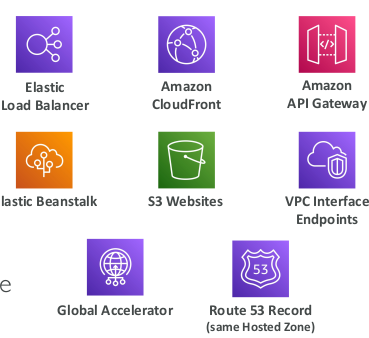
Route 53 - Alias REcords target
- Elastic Load Balancers
- CloudFront Distributions
- API Gateway
- Elastic Beantalk environments
- S3 Websites
- VPC Interface Endpoints
- Global Accelerator accelerator
- Route 53 record in the same hosted zone
- You cannot set an ALIAS record for an EC2 DNS name
Route 53 - Routing policies
- Define how Route 53 responds to DNS queries
- Don’t get confused by the word “Routing”
- It’s not the same as load balancer routing which routes the traffic
- DNS does not route any traffic, it only responds to the DNS queries
- Route 53 support the following Routing policies
- Simple
- Weighted
- Failover
- Latency based
- GeoLocation
- Multi-Value Answer
- Geoproximity (using Route 53 Traffic Flow feature)
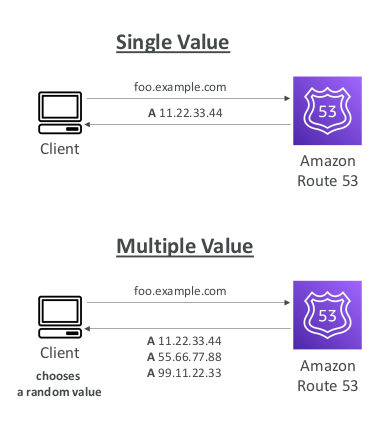
Routing Policies - Simple
- Typically route traffic to a single resource
- Can specify multiple values in the same record
- If multiple values are returned, a random one is chosen be the client
- When Alias enabled, specify only one AWS resource
- Can’t be associated with Health Checks
Routing Policies – Weighted
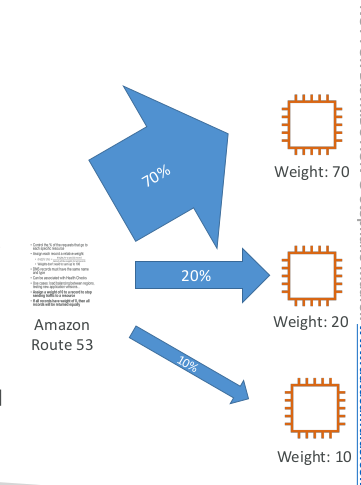
- Control the % of the requests that go to each specific resource
- Assign each record a relative weight
- traffic(%) = Weight for a specific record / sum all the weights for all records
- Weights don’t need to sum up to 100
- DNS records must have the same name and type
- Can be associated with Health Checks
- Use cases: Load balancing between regions, testing new application versions…
- Assign a weight of 0 to a record to stop sending traffic to a resource
- If all records have weight of 0, then all records will be returned equally
Routing Policies - Latency based
- Redirected to the resource that has the least latency close to us
- Super helpful when latency for users is a priority
- Latency is based on traffic betwwen users and AWS Regions
- Germany users may be directed to be the US (if that’s the lowest latency)
- Can be associated with Health Checks (has a failover capability)
Route 53 - Health Checks
- HTTP Health Checks are only for public resources
- Health Check => Automated DNS Failover:
- Health checks that monitor an endpoint (application, server, other AWS resource)
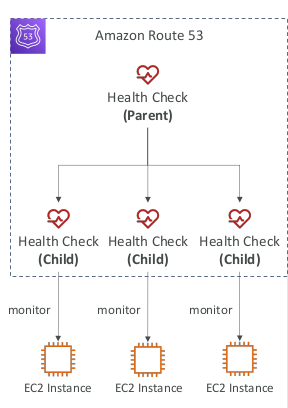
- Health checks that monitor other health checks (Calculated Health Checks)
- Health checks that monitor CloudWatch Alarms (full control !!) - e.g throttles of DynamoDB, alarms on RDS, custom metrics, … (helpful for private resources)
- Health Checks are integrated with CW metrics
Health Checks – Monitor an Endpoint
- About 15 global health checkers will check the endpoint health
- Health/Unhealthy Threshold - 3 (default)
- Interval - 30 sec (can set to 10 sec - higher cost)
- Supported protocol: HTTP, HTTPS and TCP
- If > 18% of health checkers report the endpoint is health, Route 53 considers it Health. Otherwise, it’s Unhealty
- Ability to choose which locations you want Route 53 to use
- Health Checks pass only when the endpoint respond with the 2xx and 3xx status codes
- Health Checks can be setup to pass / fail based on the text in the first 5120 bytes of the response
- Configure you router/firewall to allow incoming requests from Route 53 Health Checkers
Route 53 - Calculated health checks
- Combine the results of multiple Health Checks into a single Health Check
- You can use Or, AND, or NOT
- Can monitor up to 256 Child Health Checks
- Specify how many of the health checks need to pass to make the parent pass
- Usage: perform maintenance to your website without causing all health check to fail
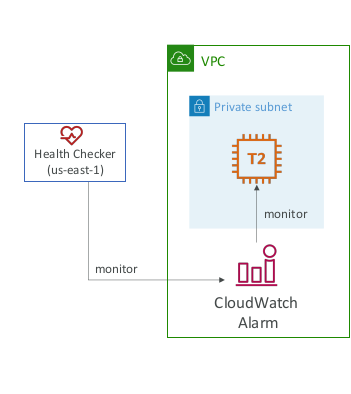
Health Checks – Private Hosted Zones
- Route 53 health checkers are outside the VPC
- They can’t access private endpoints (private VPC or on-premises resource)
- You can create a CloudWatch Metric and associate a CloudWatch Alarm, then create a Health Check that checks the alarm itself
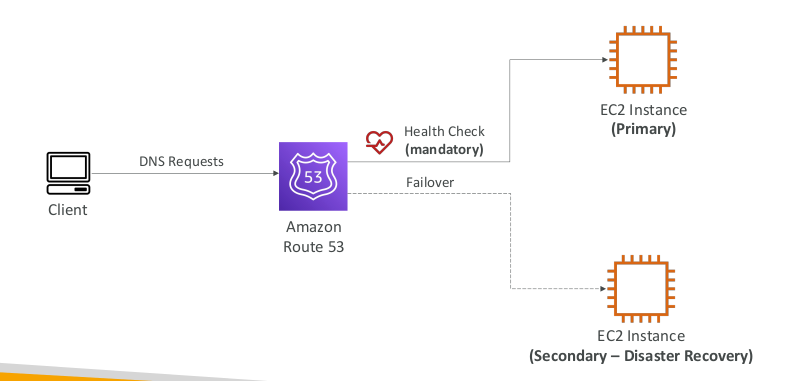
Routing Policies - Failover (Active - Passive)
Routing Policies Geolocation
- Different from latency-based!
- This routing is based on user location
- Specify location by COntinent, Country or by US State (if there’s overlaping, most precise location selected)
- Should create a “Default” record (in case there’s no match on location)
- Use cases: website localization, restrict content distribution, load balancing, …
- Can be associated with Health Checks
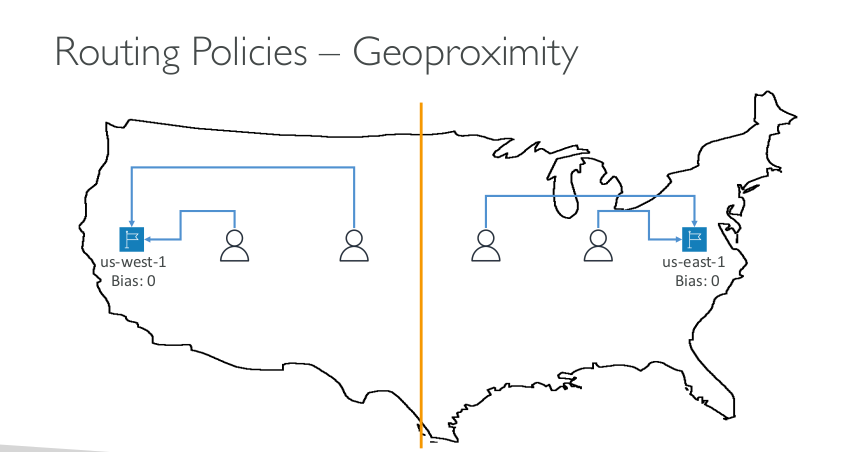
Routing Policies – Geoproximity
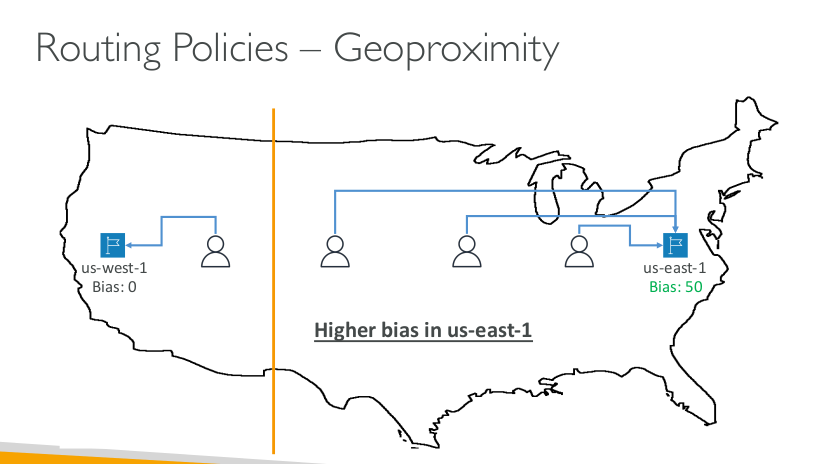
- Route traffic to your resources based on the geographic location of users and resources
- Ability to shift more traffic to resources based on the defined bias
- To change the size of the geographic region, specify bias values
- To expand ( 1 to 99): more traffic to resource
- To shrink (-1 to -99): less traffic to the resource
- Resources can be:
- AWS resources (specify AWS region)
- Non-AWS resources (specify latitude and longitude)
- You must use Route 53 traffic flow to use this feature
Routing Policies - Geoproximity
Routing 53 - Traffic flow
- Simplify the process of creating and maintaining records in large and complex configurations
- Visual editor to manage complex routing decision trees
- Configurations can be saved as TRaffic Flow Policy
- Can be applied to different Route 53 Hosted Zones (different domain names)
- Supports versioning
Routing Policies - Multi value
- Use when routing traffic to multiple resources
- Route 53 return multiple value/resources
- Can be associated with Health Checks (return only values for healthy resources)
- Up to 8 healthy records are returned for each Multi-Value query
- Multi-value is not a substitude for having an ELB
Domain Registar vs DNS Service
- You buy or register you domain name with a Domain Registar typically by paying annual charges (e.g GoDaddy, Amazone Registar Inc, …)
- The Domain Registar ussually provides you with a DNS service to manage your DNS records
- But you can use another DNS service to manage your DNS records
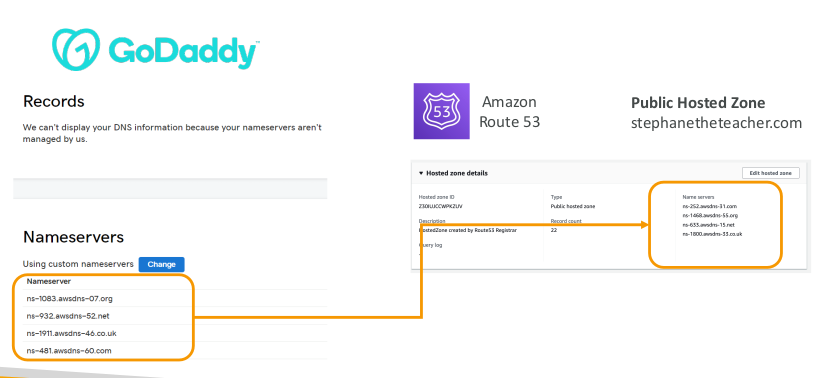
- Example: purchase the domain from GoDaddy and use Route 53 manage your DNS records

GoDaddy as Registrar & Route 53 as DNS Service
3rd Party Registrar with Amazon Route 53
- If you buy your domain on a 3rd party registrar, you can still use Route 53 as the DNS Service provider
- Create a Hosted Zone in Route 53
- Update NS Records on 3rd party website to use Route 53 Name Servers
- Domain Registar != DNS Service
- But every Domain Registrar usually comes with some DNS features
- A record mapping to IPv4
- AAAA record mapping to IPv6
- CNAME records shortcuts to hostname
- CNAME ftp
- CNAME mail
- CNAME wwww google.com zone
- MX records how email work
- MX 10 mail
- MX 20 mail.other.domain
- TXT records — query txt, spam
- TTL 3600 Time to live , numeric value in seconds authoritative
- TTL 3600 Non-Authoritative
- TTL The time for which a DNS resolver caches a response is set by a value called the time to live (TTL) associated with every record. Amazon Route 53 does not have a default TTL for any record type.
- NS: how the root zone delegates control of .org to the .org registry